Tuesday, June 4, 2013

Object Lab Day 2 - Million Dollar Chairs and Clay

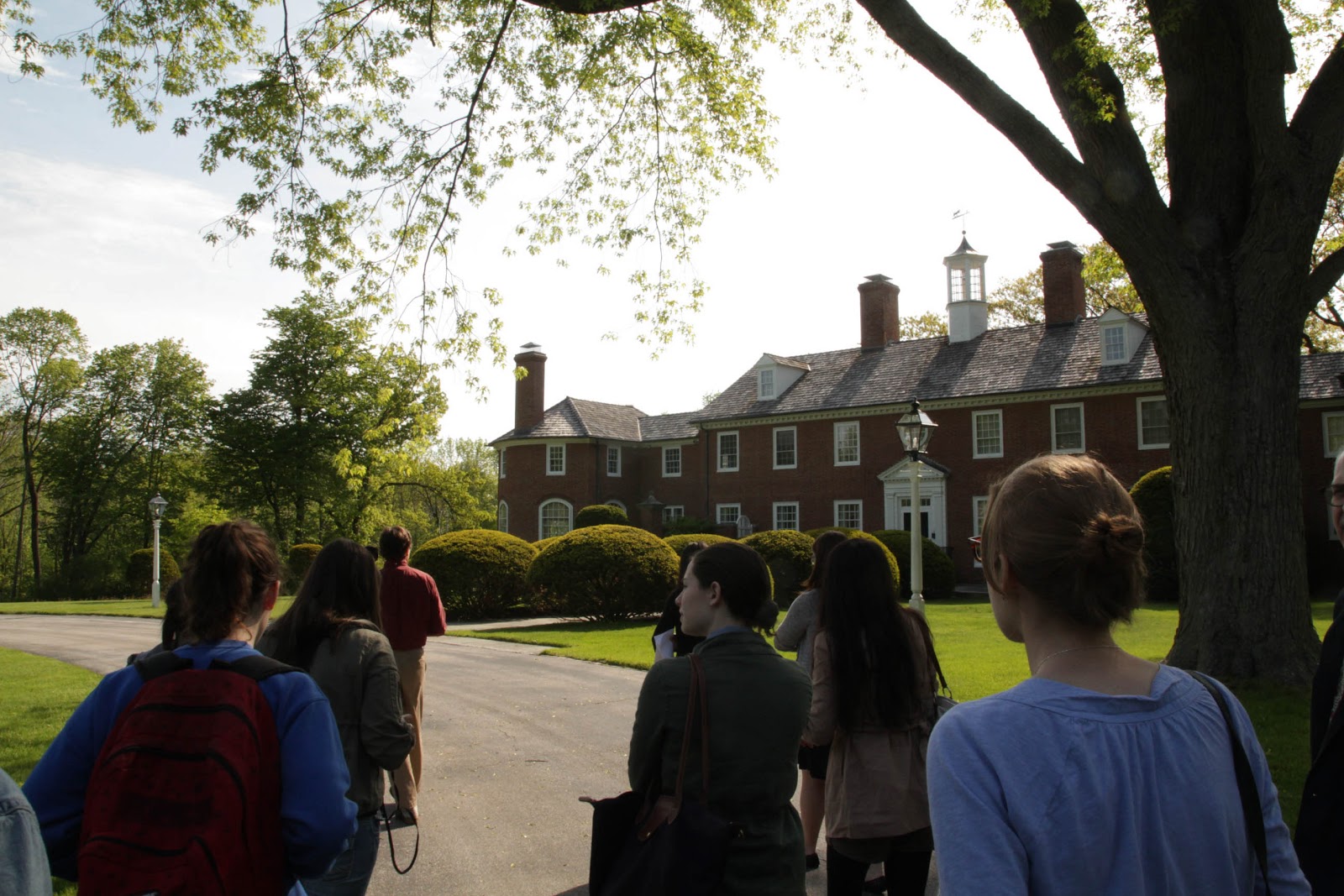
Today we spent the majority of the day at the Chipstone Estate.


First we went into a hollow beside the house,


Once situated on a really old rock wall, we read poems and quotes from very different parts of mankind. Starting with the biblical passage of Jeremiah 18:2-6, going through mythology all the way to scientists saying clay could scientifically begin life, we realized the relationship between humans and materials - specifically clay.


We then went to the house, and learned that the house was actually built in the early 1950s by a couple named the Stones who collected Early American furniture and British ceramic ware. 


They clearly caught the Williamsburg/Colonial-bug and wanted to relive the 17th and 18th century.


We learned about how ceramics and porcelain began in the Western world, originally as earthy clay ceramics made in Britain and fine porcelain made in China. 


What I found so interesting was seeing the defining characteristics this long ago (16th and 17th century) that carry over to cultural ideals. I started thinking about the delicate-ness of Asian refinement. These bowls actually were examples of real China imports and fake British made Chinese look-alikes. Something we aren't at all used to today.


Then we went into a room full of some million dollar chairs. Some were worth less, but apparently museums have gotten really jealous of this collection. 


As we started talking, I realized the greatness of the ornamentation of these types of furniture. It may have been the biggest insight of the day, but as a designer I've been indoctrinated with the Bauhaus mentality that all ornament is unnecessary. This modernist-infused thinking has come from an industrialized society that copies ornament for the sake of sales. However, these chairs had ornament for better reason than just marketing. They were way more involved in the status and personal life of their owners than we may view our furniture today. This could be a class thing - for all these chairs were owned by the upper class, which as we know think very differently than the middle class - but ornament and the way shapes were formed into each chair told a story about its owner. 


Each one of these chairs were owned by an 18th century American - So they lived in Philadelphia or Boston in the 1700s, actually before the Revolutionary War. So, what was going on in the minds of these Early Americans was establishing themselves as "new British Elite" with the clout and legitimacy that their neighbors at home had, or could marvel at. So, at this time, what could make people marvel at you? Well, first by what you were able to afford, and second probably by how impressive your possessions are. So, logically we discovered that the chairs with more carvings cost more than the simpler ones. Actually, chair customers would pay per carving! 

The other really significant thing I realized about ornamentation during this discussion was that these chairs have symbolism in their detailing that tells artistic meanings about its owner. Vase shapes in the center back, shells and dragon-and-pearl-claw feet all call symbolism to classical culture, using literature and mythology references like Venus to reflect femininity and even the power of beauty.


We then talked about some earthenwares over coffee


Actually held the first porcelain cup made in America (or one of the first, its worth a ton of money and has a cool story)


Then, we got into groups and were blindfolded and brought an object to figure out. 


We then tried to describe it to each other, and then came up with a creative description for it as if it were in a museum - only we've never actually seen it.

We named ours the "Treehouse Chair" and described it as the King of the Forest's throne that he hewed out of a tree, more on this later...


Then we shared our descriptions


Our description was:

"The Treehouse Chair: If the King of the Forests claimed a tree as his throne, he would carve a seat out of a sturdy trunk and the back of his chair would be shaded by leafy foliage. The Treehouse Chair, with its sturdy tree trunk-like three legs, its simple hewn timbers, this piece of early American furniture exemplifies how true organic craftsmanship mimics nature and its honesty to material."


 This table was originally meant as a dressing table for a bedroom.


The group thought it had earrings. 
Makes sense!


We then were given buckets!


And then went to the carriage house,


And found lunch!


And we got to eat like 18th century people, which got us on a discussion about how societies eat and find nutrition. It was fascinating, people who worked back-breaking hard labor pretty much just ate this, and didn't get much nutrients...

We also talked about how unnatural eating bread and milk-based foods is to the human body. Which was interesting to ponder... We might want to make sure we're eating balanced, and this was quite refreshing.


Then we went to an antique store! We were given 20 dollars to find a treasure that spoke to our senses, and basically we went wild


Later on we talked about how our treasure actively and meaningfully engaged us (and our senses)


And we had many interesting things, ranging from corn teapots to cast-iron elephants


and my deco-expressive pot-thing I found. (I think its a casserole dish...)
I thought it was particularly engaging because of how strong and expressive it was. It seemed like it wasn't afraid to let its energy loose, but it also had a beautiful orderliness that made me think of the speed lines found in the expressions of art deco architecture and even how the ocean's sea foam layers itself on the beach.


Also today we learned about making things!


Randy over there is an expert furniture maker,


He was showing us how to plane wood, hand-drill holes and do all sorts of furniture making like the early Americans did, without machines.


We also did pottery turning!


A hand turned lathe too!


In the end, I started to carve out a spoon, and didn't get it finished just yet. But isn't that yellow wood cool?! 


After everything today, I briefly sat down to read and found this cool quote that I think relates to what we were learning about how objects can relate to our humanity. We were learning about what ornamentation did for early Americans artistically, and if what that particular way of beauty was a personal achievement symbol or artistic expression of achievement, what implications does a thought like this have on the world of designed objects?

"And it is the brittleness and bitterness of contemporary debates about civil matters that Wolfe feels the 'intuitive language of the imagination' can and must positively contribute to. Art does this not by avoiding difficult things and emphasizing feelings, but by being an alternate mode of reasoning and understanding. Wolfe believes the arts can counterbalance the pragmatic and utilitarian ethos of political efficiency with 'the necessary contemplative space that pulls us back from the realm of action in order to send us back wiser and more fully human' [22]."  


This quote is from a larger post written by James Mccullough on an arts, culture and theology blog called Transpositions. The full article, which is a review on a book, can be found here: http://www.transpositions.co.uk/2011/10/beauty-will-save-the-world-a-review/


Monday, June 3, 2013

Object Lab Day 1

Today was the first day of the Chipstone Foundation's Object Lab!

I've been able to have the opportunity to go to Milwaukee and study objects, such as decorative arts like furniture and ceramics, and art curation and history with a group of other students from all over the country. Today, I was sent by train to the Milwaukee Art Museum and grabbed my camera and started to take photos:


Getting off the train...


And to the museum!


When we first arrived, we read and discussed the poem "A Sort of Song" by William Carlos Williams

Let the snake wait under
his weed
and the writing
be of words, slow and quick, sharp
to strike, quiet to wait,
sleepless.
-- through metaphor to reconcile
the people and the stones.
Compose. (No ideas
but in things) Invent!
Saxifrage is my flower that splits
the rocks. 

We began to tour the museum, first to see the Chipstone Exhibit Space


The first thing we found about the Chipstone Exhibit was that all these chairs were out on the floor to sit in!


See any famous chairs? (designers, you can pick them out.. right?) What was really cool about this is they had us all sit in them..


We then talked about how they felt to sit in, and what each meant to that person as they experienced the chair. Mine (the white lounge chair of course) felt "springy"and made me think it was somewhat risky.


These we decided were somewhat oppressive chairs, only the one on the right was more like a Dwarf King's chair than an Emperor's throne because of how quirky it was.


We then talked about this pot.. 


which was made by a slave named Dave from the old plantation days! Not only was that bit of history cool, but he also was a crazy genius with poetry, and knew that the stories he wrote in the poems on his pots would matter someday later in the future...


We then went into this exhibit that creatively teaches us about the original museum: the Cabinet of Curiosity


This cabinet was reflecting its foliage virtues, basically how a cabinet comes from nature


Here the cabinet seems to imitate nature...


We noticed that the feet really give that away (not to mention how it looks like these animals are hanging around a tree)


Doesn't that look like a tree? From a Hitchock movie or something...  but what was really intriguing was that those animals were all taxidermy...


That whole taxidermy thing made us think more about cabinets...


Because then with this last one we figured out that the Cabinets of Curiosity were ways for humans to fit their role between creation and the divine by studying it and sharing it with others. (That may sound outdated...but thats another discussion, it also fits in with the era these existed) This really helps to reflect on our call to wonder and fascinate on the world around us, and how we've done it in the past! Look how this piece of furniture even looks like the one with all the birds on it, only these are real wood. 

That made me think about ornamentation and why it exists...


Anyways, we move on and look at other objects in the exhibit


And find a human-like chair, with arms and legs as explicit as you can get,


and this was all part of an exhibit that tells the human relationship stories of furniture pieces


which had mythology uncovered in its tables (these were owned by bankers and businessmen-symbolizing strength and stability with griffins and so on)


Then came the display that made me think the most: the narrative of death found in puritan era furniture. What I thought was so amazing was that these puritan age people were so accustomed to the idea of death that they didn't mind living with furniture pieces that specifically reminded them of it! What was interesting is that this topic is suppressed in our modern time, but it seems to have been embraced, and even emphasized back then. Some people said it was because puritans were always sick and were very serious, but I'd say that they also had a strong anticipation for the "new heavens and new earth" that was to come after their lives on earth was done. It all has to do with how since Christians are saved by Christ, they aren't afraid of death and actually look forward to it because they'll be finally with Christ and away from all the sickness and pain of the world.

That was a really cool discovery today.


This was a cool curvy chair


And this was a really great glass exhibit that I thought was such a perfect contrast to the medieval riches surrounding it


This was exciting...made of felt!


amazing abstracts...


Then we talked about it all! We also discussed in depth thoughts about the success of exhibits, curation,  museums and other arts and culture things. It was so interesting to find out that museums (after the cabinet of curiosity) were used by governments to instruct the country of the standards of living. Basically the idea of being quiet in museums came from the 19th century high standard of conduct, and all the subject matter was of art and artifacts that established cultural values and ideals. At least this is to the best of my knowledge from our discussion.


Then we went to dinner!


More posts to come, tomorrow will be jam packed with new and amazing things!


Monday, April 1, 2013

The Language of Things - Final Reading Notes


Throughout his book, The Language of Things, Deyan Sudjic visits many interesting aspects of how everyday objects have a hold in the world. He began by explaining the different experiences through designers and movements in design, from Raymond Loewy to Philippe Starck. Though each hot shot designer has seemed to give the world an opinion about what design should really be, designers mainly can only provide different opinions instead of absolute truth. Through his first section on Language, I discovered that the world of design is driven by many different ideas, and each idea has value in an ever-changing world of product consumption. In this first chapter, what I found interesting was how those ideas can work well as language. Each form has a different linguistic property that communicates different ideas and perspectives. Sudjic writes: 

“...You might look at the Soviet and American space capsules that docked in Earth orbit, and which now hang in the Smithsonian Museum in Washington, and see two different national mentalities rendered in physical form. They are two objects designed to do exactly the same thing, in the most extreme of conditions. And yet they look utterly different, and reflect with shattering clarity two utterly different political and economic systems. One looks as sleek as a Harley Earl limousine, the other seems to belong in the world of Jules Verne, of brass portholes and mahogany fittings.” (Sudjic, 42)

In his next chapter, Sudjic explores the phenomenon of archetypes in design. These are objects that would be considered as the “quintessential work lamp” or “ultimate safari vehicle.” Archetypes have an identity that define their category. If one looks at a box of tissues, many societies will address that box a “box of Kleenex” because it has become an archetype of disposable tissues. The chapter talks about how these archetype languages impact a product’s emotional connection. Because the Anglepoise lamp is known as “The Work Lamp,” it has an emotional engagement revolving around work. “To switch on an Anglepoise and move it into position is, both literally and metaphorically, to suggest that you have started to work. It is like opening the shutters of a shop, or raising a curtain in a theatre. All the senses are involved, sound as well as touch. The click of the switch is like putting up a ‘Do not disturb’ sign.” (Sudjic, 56).

Then Sudjic spends time explaining Luxury and how high society has defined itself first through employing craftsman and artisans to acquire possessions, and now has evolved into a modern style of consumption. The language of much craft luxury has been that a wealthy person had the money to have someone skilled and valuable make their things. Their things would be incredibly valuable, because the level of quality and artistry they had were far more costly than what any normal person could afford. However, now in our modern industrialized society, the level of quality and artistry has become greatly democratized because of mass production, so luxury has had to define itself in different ways. Sudjic says “Contemporary luxury depends on finding new things to do that are difficult. Ii can be using more of a material than is strictly necessary... Before the newest technologies made complex forms easy to make on the production line, luxury cars came with curves that were difficult to form in metal, and cheaper models tended to have boxier silhouettes, or simpler curves: the difference between the original Citroen 2CV and the complex multiple curves of a contemporary Maserati.” (Sudjic 120).

As he explains the different examples of how luxury has changed in society, it becomes evident that luxury comes down to spending more money than others. This can be a very useless thing to some, but in other realms of society, it is an important aspect of their lives. Sudjic closes his chapter saying “Luxury in our times revolves more and more about the details that persuade consumers to spend money. But another definition of luxury - one that is closer to its original meaning - may prove increasingly pertinent. IT sees luxury as the way to provide a sense of respite from the relentless tide of possessions that threatens to overwhelm us.” (Sudjic 129). So, basically it comes down to special-ness.

The last two chapters in his book are on Fashion and Art. These both were extremely revealing, in that many designers hope to be artists, and both fashion and art have a powerful status in the world. As Sudjic puts it, fashion, which began as a craft and now has turned into an industry, uses image and art to create business. It does not have a set format of rules, as the old perception of luxury had when it appreciated fine craftsmanship, but it constantly changes its rules in order to make business. Fashion does not only make money, but it also defines social statuses. “If fashion is about defining those who belong and those who don’t” Sudjic writes “then so is a uniform.” (156). Uniforms define the character an army or police force wishes to convey. Just as the Marines have a dress uniform and a camouflage uniform to define different situations or actions, the type of clothing worn defines the character of an individual and how they want to be perceived. This also relates to the planned obsolescence phenomenon fashion depends on. When something goes out of style, then that person is perceived differently than if they wore something that was in style. The same thing drives other industries.

The chapter on art explains the roles of art and design in objects. Designers can sometimes make art, but since art is basically defined as being something that is useless, it is very rare that design becomes art. What was interesting is that art has gone through a serious evolution that has redefined the role of art in the world. It also has been an important part of other creative areas, such as furniture and advertising. What has evolved is a conflicted line being drawn in the sand between art and design. It is conflicted because of how both fields are creative, and each one has the capability to feed into the other. However, Sudjic suggests that the complicated interaction between both fields will cause a new category to emerge. He says “the ideology of design has been intimately bound up with problem-solving. Now we are being offered an entirely different category of object. It is not one that is likely to do much in the short term to shift the relative positions in the social hierarchy of art and design.”

What has been helpful from reading this book is how it has provided a deeper knowledge of what design is. There is a responsibility that any creative person has when taking on any of these different fields, be it fashion, product design or art. One should know what he or she is doing just as much a person should when in a conversation with another person.

Bibliography
Sudjic, Deyan. "Chapter 1: Language." The Language of Things. London: Allen Lane, 2008. N. pag. Print.

Friday, March 8, 2013

Art Deco Study Analysis

Here is the presentation I put together from my first round of analyzing the images I've found inspiring. I took the photographs I took of art deco building around Chicago and studied the line properties of each image, finding similarities to the images I found in Tumblr.


Here's the link to my Tumblr